
Affect vs Effect: A Clear Guide to Using Them Correctly
Have you ever paused mid-sentence, wondering whether to use “affect” or “effect”? You’re not alone! These two words are among the most commonly confused in the English language. While they sound similar, their roles in a sentence are distinct, and understanding the difference is key to clear and precise communication.
In this article, we’ll demystify “affect” and “effect” with plenty of examples, helpful tips, and even a few visuals to solidify your understanding.
The Core Difference: Verb vs. Noun
Affect vs Effect – The simplest way to remember the difference is this:
- Affect is almost always a verb (an action word).
- Effect is almost always a noun (a person, place, thing, or idea).
Let’s dive deeper into each.
Affect vs Effect – Affect (Verb): To Influence or Change
As a verb, “affect” means to have an impact on, to influence, or to cause a change in something or someone. Think of it as “to act upon.”
Examples:
- The cold weather will affect crop growth. (The weather will influence the crops.)
- His positive attitude affected everyone in the room. (His attitude influenced the people.)
- Lack of sleep can seriously affect your concentration. (Lack of sleep impacts your concentration.)
- The new policy affected all employees. (The policy changed things for the employees.)
- How will this decision affect our future plans? (How will this decision influence our plans?)
Tip: If you can replace “affect” with “influence” or “impact” (as a verb), you’re likely using it correctly.
Visual Aid: The “Affect” Action

Imagine a domino effect. The first domino affects the second, which affects the third, and so on. It’s an action, a cause leading to a change.
Affect vs Effect – Effect (Noun): The Result or Outcome
As a noun, “effect” refers to the result, consequence, or outcome of an action or cause. It’s the “thing” that happened.
Examples:
- The cold weather had a negative effect on crop growth. (The result of the cold weather was negative for crops.)
- His positive attitude had a great effect on everyone. (The outcome of his attitude was positive for people.)
- The new medication had several side effects. (The consequences of the medication were side effects.)
- What was the effect of the new policy? (What was the result of the new policy?)
- The special effects in the movie were stunning. (The results of the special effects work were stunning visuals.)
Tip: If you can replace “effect” with “result” or “consequence,” you’re likely using it correctly.
Visual Aid: The “Effect” Result

After the dominos fall (the “affect”), the fallen dominos are the “effect” – the observable result.
Comparison Chart: Affect vs Effect
| Feature | Affect | Effect |
| Part of Speech | Verb (usually) | Noun (usually) |
| Meaning | To influence, to change, to impact | The result, consequence, outcome |
| Synonyms | Influence, impact, sway, modify | Result, consequence, outcome, impact (noun) |
| Question | What did it do? | What happened? |
| Example | The rain affected the game. | The rain had a large effect on the game. |
The Exceptions: When the Rules Bend
English wouldn’t be English without exceptions, right? While the verb/noun rule covers most cases, there are a couple of instances where “affect” and “effect” switch roles.
1. Effect as a Verb (To Bring About)
This is much less common, but “effect” can be used as a verb meaning “to bring about” or “to accomplish.” It often implies creating a change or bringing something into existence.
- The new manager hoped to effect positive changes in the department. (To bring about positive changes.)
- The committee worked to effect a compromise. (To achieve a compromise.)
Tip: If you can replace “effect” (as a verb) with “to bring about” or “to accomplish,” it’s likely correct.
2. Affect as a Noun (An Emotion or Mood)
In psychology, “affect” can be used as a noun to refer to an observable expression of emotion or mood. This is a technical term and you’re unlikely to encounter it in everyday conversation or writing.
- The patient’s affect was flat. (Meaning their emotional expression was subdued.)
Unless you’re writing a psychology paper, stick to “affect” as a verb.
Memory Aids
- RAVEN: Remember Affect is a Verb, Effect is a Noun.
- A is for Action: “Affect” starts with ‘A’ and is usually an action (a verb).
- E is for End Result: “Effect” starts with ‘E’ and is usually the end result (a noun).
Practical Application: Let’s Practice!
Choose the correct word for each sentence:
- The doctor explained how the medication would _______ the patient’s recovery. (affect / effect)
- The new regulations will have a significant _______ on small businesses. (affect / effect)
- Did the speech have any lasting _______ on the audience? (affect / effect)
- His personal problems began to _______ his work performance. (affect / effect)
- The goal is to _______ a smooth transition to the new system. (affect / effect)
Answers:
- affect (verb – to influence)
- effect (noun – the result)
- effect (noun – the outcome)
- affect (verb – to influence)
- effect (verb – to bring about)
Here is a PDF worksheet you can download to practice Affect vs Effect. The answers are on a separate page.
Additional Helpful Content: Understanding “Impact”
To add another layer of confusion, the word “impact” can also be used as both a noun and a verb, sometimes interchangeably with “affect” and “effect.”
- Impact (Verb): To have a strong effect on. (Similar to “affect”)
- The new law will impact everyone.
- Impact (Noun): The effect or influence of one thing on another. (Similar to “effect”)
- The new law will have a major impact on everyone.
While “impact” can often be a substitute, “affect” and “effect” often offer more nuance and precision. It’s good to have all three in your vocabulary toolkit!
Frequently Asked Questions (FAQ) – Affect vs Effect
Q: Is there ever a time when “affect” is a noun in common use?
A: Not typically in everyday language. Its use as a noun for “emotional expression” is primarily in psychology or psychiatry.
Q: How can I tell if I should use “effect” as a verb?
A: If you mean “to bring about” or “to accomplish,” then “effect” can be used as a verb. This usage is more formal and less common than “affect” as a verb.
Q: Can I just use “impact” instead of “affect” or “effect” to avoid confusion?
A: While “impact” can often be used, mastering “affect” and “effect” shows greater precision and command of the English language. Sometimes “impact” can sound a bit strong or informal when “affect” or “effect” would be more appropriate.
Q: What’s the biggest mistake people make?
A: The most common error is using “effect” as a verb when “affect” is needed (e.g., “It effected me deeply” instead of “It affected me deeply”).
Conclusion – Affect vs Effect
Mastering “affect” and “effect” is a significant step toward improving your writing and speaking clarity. Remember the core rule: affect is usually a verb, effect is usually a noun. With a little practice and these handy tips, you’ll be using them correctly in no time!
Additional Helpful Links
- More information about English conditionals – Mixed Conditionals: Intermediate English Guide
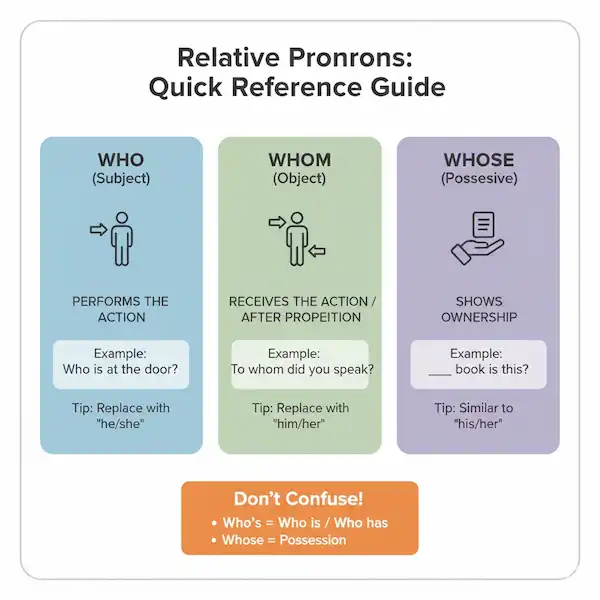
- Clear up the confusion about using Who, Whom, and Whose – Who Whom Whose: Mastering Relative Pronouns
External Links for Authoritative Sources:
- Merriam-Webster Dictionary: https://www.merriam-webster.com/words-at-play/affect-vs-effect-difference
- Purdue OWL (Online Writing Lab): https://owl.purdue.edu/owl/general_writing/common_errors/affect_vs_effect.html
- Grammarly Blog: https://www.grammarly.com/blog/affect-vs-effect/