Possessive Pronouns Explained: ‘My’, ‘Your’, ‘His’, & ‘Her’ for Beginners
Article Summary (Key Takeaways):
- Possessive pronouns show who owns something. They answer the question, “Whose is it?”
- My = Belongs to me.
- Your = Belongs to you.
- His = Belongs to a boy or man.
- Her = Belongs to a girl or woman.
- The formula is simple: Possessive Pronoun + Noun (e.g.,
my book,her cat).
Hello, English learners! Welcome. My name is Teacher Kay, and I’ve been teaching English for over15 years. A question I hear all the time is about words like ‘my’, ‘your’, ‘his’, and ‘her’. What do they mean? How do we use them?
Don’t worry! It’s much simpler than you think. These words are called possessive pronouns, and they are essential for sounding natural in English. Let’s learn them together.
What Does “Possessive” Mean?
First, let’s understand the word “possess.” To possess something means to own it or have it.
- I possess a pen. → It is my pen.
- You possess a phone. → It is your phone.
So, possessive pronouns show ownership. They tell us who something belongs to.
(Image suggestion for a real web article)
Meet the Possessive Pronouns
We use a specific possessive pronoun depending on who the owner is. Today, we will focus on the four most common ones.
1. My (Belongs to Me)
We use my when you are talking about something that belongs to you (to ‘I’).
The formula is: My + [noun]
Examples:
- “I have a cat. My cat is very friendly.”
- “My name is Andrea.”
- “This is my house. Do you like it?”
- “I can’t find my keys.”
- “What is my score on the test?”
2. Your (Belongs to You)
We use your when you are talking about something that belongs to the person you are speaking to (to ‘you’).
The formula is: Your + [noun]
Examples:
- “You have a nice shirt. I like your shirt.”
- “Is this your bag?”
- “Please write your address here.”
- “Don’t forget your umbrella. It’s raining!”
- “Your English is getting better every day!”
3. His (Belongs to a Him)
We use his when you are talking about something that belongs to a boy or a man (to ‘he’).
The formula is: His + [noun]
Examples:
- “That is my brother, David. His car is red.”
- “He forgot his lunch at home.”
- “What is his job? He seems very busy.”
- “The dog wagged his tail.” (We often use ‘his’ for male animals).
- “I have a question for the teacher. What is his name?”
4. Her (Belongs to a Her)
We use her when you are talking about something that belongs to a girl or a woman (to ‘she’).
The formula is: Her + [noun]
Examples:
- “My mother is a doctor. Her hospital is downtown.”
- “She is looking for her phone.”
- “Her idea was excellent.”
- “I love Maria’s painting. Her talent is amazing.”
- “The little girl held her mother’s hand.”
Quick Comparison Table
| If the owner is… | Use this possessive pronoun… | Example Sentence |
| I | My | This is my coffee. |
| You | Your | Is this your seat? |
| He (a male) | His | His name is John. |
| She (a female) | Her | Her dog is small. |
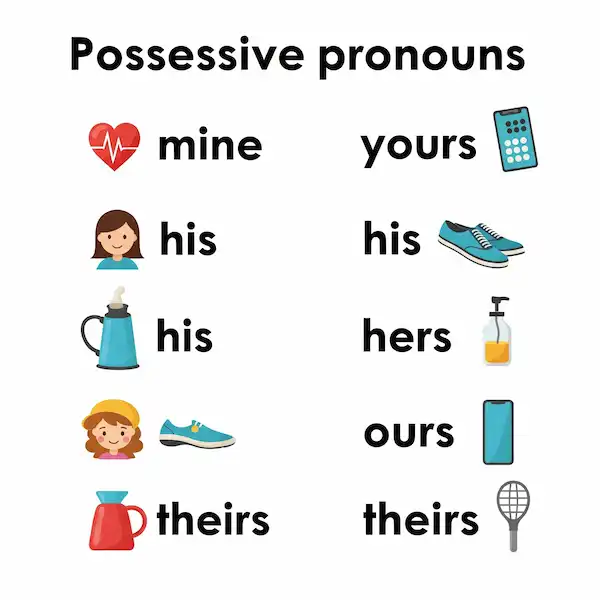
Possessive Pronouns show ownership and stand in for a noun. They do not come before a noun.
| Person/Number | Possessive Pronoun | Example |
| First Person Singular | mine | That book is mine. |
| Second Person Singular | yours | Is this umbrella yours? |
| Third Person Singular (masculine) | his | The car is his. |
| Third Person Singular (feminine) | hers | The idea was hers. |
| Third Person Singular (neuter) | its | The dog wagged its tail. (Note: “its” is a possessive adjective, not a pronoun, but often confused with “it’s” which means “it is” or “it has”) |
| First Person Plural | ours | The victory was ours. |
| Second Person Plural | yours | The decision is yours to make. |
| Third Person Plural | theirs | The house down the street is theirs. |
Common Mistakes to Avoid!
As a teacher, I see these simple mistakes all the time. Watching out for them will make your English much better!
1. Your vs. You're This is the most common mistake!
- Your shows possession. → “Your book is on the table.”
- You’re is a short form of “you are”. → “You’re a good student.” (
You area good student).
How to check: Try to say the sentence with “you are”. If it makes sense, use you're. If it does not, use your.
- “You are book is on the table.” (Incorrect) → Use your.
- “You are a good student.” (Correct) → Use you’re.
2. Possessive Pronouns Don’t Use Apostrophes ('s) Words like his and her already show possession. You do not need to add an apostrophe s.
- Incorrect: That is hi’s car.
- Correct: That is his car.
- Incorrect: Her’s bag is new.
- Correct: Her bag is new.
Let’s Practice!
Choose the correct word (my, your, his, her) to complete the sentences. The answers are below.
- I have a sister. ______ name is Sofia.
- (Speaking to a friend) Can I borrow ______ pen?
- That is Tom. ______ last name is Smith.
- I am doing ______ homework now.
- Look at Sarah! I love ______ new dress.
(Answers: 1. Her, 2. Your, 3. His, 4. My, 5. Her)
Here is a PDF document you can download with 25 practice sentences using possessive pronouns. The answers are on a separate sheet.
Conclusion
Great job! You now understand the basics of my, your, his, and her. These small words are very powerful. Using them correctly will help you speak and write English more clearly. Keep practicing, and don’t be afraid to make mistakes. That is how we learn!
For Further Learning (Authoritative Sources)
- More information about nouns and pronouns – What are Nouns and Pronouns in the English Language?
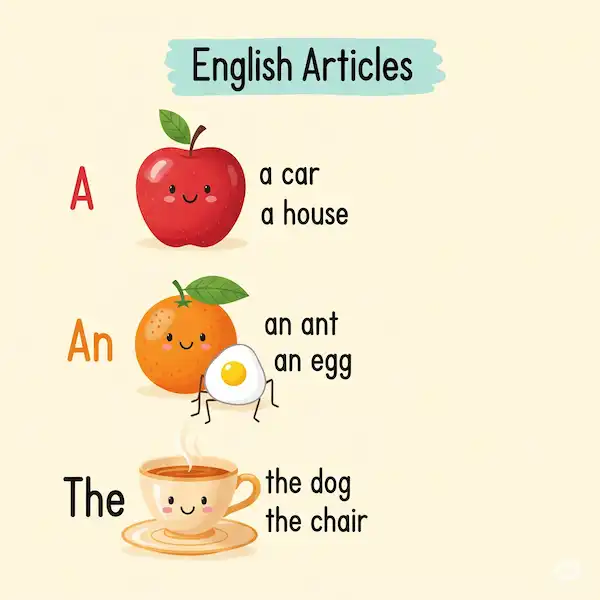
- English Articles explained – Master English Articles: When to Use A, An, and The
- To continue your learning journey, I recommend these excellent and trustworthy resources:
- Cambridge Dictionary: Definition of Possessive Determiners (my, your, his, etc.)
- British Council – Learn English: My, Your, His, Her – Grammar Lesson
- Merriam-Webster Dictionary: Definition of ‘My’ – You can search for the other words here, too.
Good luck with your studies!